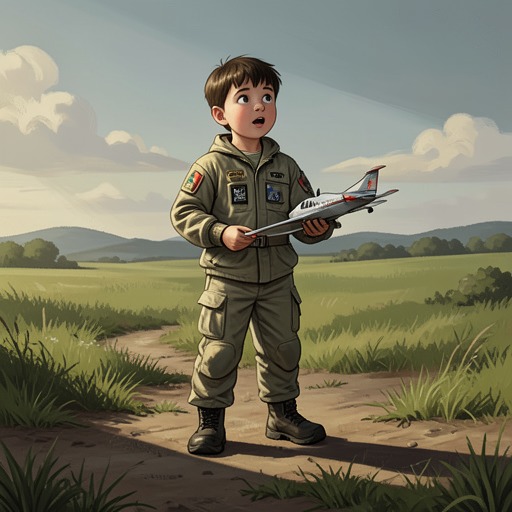
Franz joins the air corps and becomes a pilot
The Master Butchers Singing ClubFranz joins the air corps and becomes a pilot, transforming an early fascination with aircraft into both a practical skill and a refuge from emotional pain. First announced as a blunt declaration of enlistment, his choice grows through work at the airfield into a disciplined command of flight. The sky offers him a place of exhilaration and composure, but it does not erase the love and uncertainty he carries on the ground.
The decision to enlist
At a family gathering, Franz announces that he is going into the air corps and enlisting. He makes the announcement alongside his recognition that Delphine and Fidelis are getting married, as though both changes belong to the same moment of family news. Fidelis protests that there is no war. Franz answers that he expects one and acts out an airplane taking off, skimming his hand toward the open sky. His confidence meets Fidelis’s distress rather than approval: Fidelis still hopes for peace and leaves the room hunched with worry.
The exchange establishes flight as more than an occupation Franz might pursue. He imagines war coming and sees himself in the air when it does, while his father resists the future his son treats as inevitable. Franz’s gesture makes the choice vivid before he has earned the ability to fly: the hand-plane is at once a boyish performance and a declaration of the adult life he intends to enter.
Learning to fly
Franz’s route into aviation begins at the airfield, where he works on airplanes whenever Fidelis lets him leave the shop. His feelings for Mazarine occupy him painfully, but mechanical work provides a different kind of concentration. He watches the other men around the machines and initially regards their apparent attachment to machinery as a limitation; eventually he understands the relief of fixing a touchy engine. In payment for his work, Pouty Mannheim teaches him to fly.
Flight intensifies a sensation Franz first knew from the field behind his house, watching a plane lift over the windbreak. Once inside the aircraft, he learns to control it, read the wind, and interpret the signs in the clouds. On their eighth flight, Pouty gives him a turn at the controls. Their lessons then advance from takeoffs and landings to stalls, spins, wingovers, and gentle loops—the repertoire of a beginning barnstormer.
When Pouty finally permits Franz to fly alone, the experience combines risk with exacting attention. Alone in a plane whose balance feels both delicate and thrilling, Franz fixes his course on the town grain elevator, a thin mark on the horizon. He performs a slow point roll, then a more complicated hesitation roll, a loop, and a difficult spin. The earth turns over him, and concentration becomes imperative: the world is simple upside down, but only if he remains focused. He lands in a state of absolute peace.
Flight as refuge and discipline
The solo flight does not resolve Franz’s separation from Mazarine. It gives him another way to endure it. He has been longing for the remembered physical closeness of their childhood—her wobbling between his arms as he steered a bicycle, her laughter as she tried to balance—and he interprets her distance as evidence of how much he loves her. At night he cycles through imagined ways to win her back, while noticing her quietness, seriousness, thinness, and tightly braided hair. The airfield is the only thing that truly diverts him from these thoughts.
After landing from his first solo flight, Franz wonders whether he could survive losing Mazarine if he spent his life in the air. That possibility links flying to both release and avoidance: the aircraft lifts him physically from the earth, while the demands of reading weather and controlling the plane replace the bewilderment of a strained relationship with a task that has clear consequences. In flight, misjudgment can be fatal, but attention gives him a route toward calm. His peace is real, though it depends on leaving the ground—and its unresolved attachments—behind for a time.
Wartime service and reassignment
Franz’s later account of his military work revises the image of himself as a fighter pilot. He tells Mazarine that he will not be in the worst of the fighting: he drops paratroopers or tows and releases gliders, and he has been reassigned from fighter-pilot work. He flies a C-47 transport plane, evacuating wounded people and delivering supplies such as food, clothes, and medicine. The work still places him in wartime aviation, but its stated function is transportation, supply, and evacuation rather than combat in a fighter.
Franz says that he was reassigned and struggles to find a name for what has happened to him, settling on being tired out. The quiet admission contrasts with the exuberant childlike gesture of his first announcement. Flying remains his world, but his role has changed: instead of defining himself through the fighter pilot he expected to become, he describes the practical tasks his transport assignment requires.
The beaver insignia and the meaning of flight
Franz is assigned to the 439th Troop Carrier Group, whose emblem is an angry beaver. In a letter to Mazarine, he jokes about the group’s insignia and describes the beaver as mean-looking, with transport wings growing from its shoulders and a missile in its paw. The humor gives a concrete emblem to a service identity that is otherwise defined by reassignment and fatigue.
The same letter turns from the emblem to Franz’s memories of Mazarine and his changing understanding of himself. He says that the person he has become is tougher, yet looks upon the world from far above as calm rather than tortured, and acknowledges a surrender in his heart. He connects flying forever with the mysterious hours of their youth and imagines telling a future child that they had loved each other since school days. Flight therefore persists not simply as escape or military work, but as the setting through which Franz reconsiders love, endurance, and the life he may share with Mazarine.